



Executive Summary
Many companies have set near term net-zero targets, most commonly for 2030. These targets could be a source of increased corporate action and climate finance while allowing companies to make credible claims, but they could also be fulfilled using low-quality instruments, or silently dropped leading to a missed opportunity and lowering ambition.
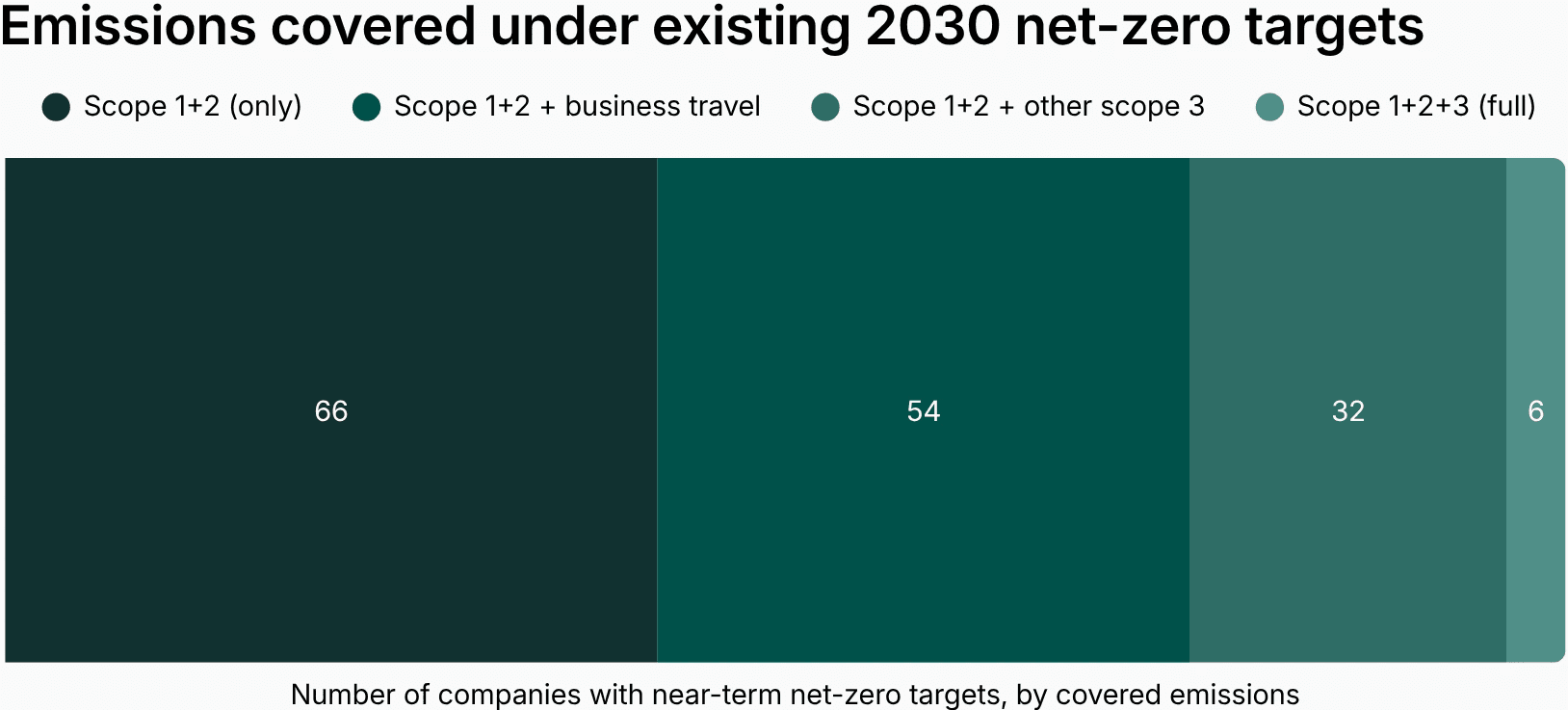
Near term net-zero targets are typically for operational emissions only. Of the companies with net-zero targets for 2030, a majority of them only consider their Scope 1+2 and sometimes parts of Scope 3 such as business travel under their targets.
These operational net-zero targets give companies an ability to make a claim and get a clear win in the near term. But there is currently no guidance from standard setters on how such targets should be structured or achieved. This creates a risk that companies use very different approaches to reach these targets, possibly undermining the integrity of their claims.
Using the Net Zero Tracker dataset, and a wider search, we identified 158 companies with net-zero targets by 2030 or earlier. The spectrum of how companies are planning to reach their targets is wide. At one end, companies combine aggressive emissions reductions with durable carbon removal procurement and transparent reporting. At the other, companies plan to claim net zero through cheap avoidance credits or have not specified how they plan to reach their targets. An additional 1500 companies have set longer-term net-zero targets, and could be encouraged to start taking responsibility for their operational emissions today.
It is mainly “high-profit, low-emission” companies that have set operational net zero by 2030 targets. This does not diminish the value of the concept. Companies that can, should be encouraged to take responsibility for their emissions and spend money on external climate projects.
This paper defines operational net zero, proposes four criteria for credible claims, and lays out a 2026–2030 action plan. Our recommendations address three audiences. For companies with existing 2030 targets: define your operational boundary, reduce aggressively, and begin phased carbon removal procurement now. For companies with long-term targets only: consider adopting an operational net-zero commitment for the emissions you control. For the standards ecosystem: recognize operational net zero needs as a credible, distinct milestone within emerging frameworks.
Operational net zero is not the only credible near-term path. Setting an internal carbon fee and directing the proceeds to high-impact climate projects — without constraining the spend to what GHG accounting will let a company claim — can represent just as high, or even higher, ambition. But operational net zero offers something many companies want: action that counts toward their targets.
Nor is it an end point. Reaching operational net zero does not release a company from responsibility for its value chain emissions. Companies should spell out what wider change is needed to reach their full net-zero targets and work toward that change. What operational net zero offers is a way to turn long-term ambition into near-term action, a commitment companies can achieve now, while making a meaningful contribution to the climate transition.
What is operational net zero?
Operational net zero is a bounded net-zero claim covering a company’s operational emissions, typically Scope 1, Scope 2, and selected Scope 3 categories such as business travel. These emissions do not map perfectly onto the emissions within direct corporate control (some Scope 3 emissions are clearly controllable, while some emissions within Scopes 1 and 2 remain constrained by wider infrastructure or policy conditions), but they are often the closest practical approximation within current GHG accounting (1). An operational net-zero target can exist as a near-term milestone within an organization’s long-term net-zero strategy or it can be implemented as a starting point for companies that want to take responsibility for emissions under their control.
For asset-light and service-based companies business travel can be the single largest emission source under a company’s direct control. Companies decide whether a meeting is virtual or physical; they set travel policies, determine class of service, and choose transport modes. In these cases, corporate decisions directly determine whether these emissions occur. Excluding business travel from an operational net-zero claim would create a weak and potentially misleading boundary.
In practice, achieving operational net zero means taking three steps. First, include controllable Scope 3 emissions (like business travel) within your operational boundary. Second, reduce Scope 1, Scope 2, and controllable Scope 3 emissions as far as technically and financially feasible by 2030 through electrification, energy efficiency, renewable energy procurement, and operational changes. Third, neutralize any remaining operational emissions annually using high-quality, durable carbon removal.
(1) We give more details on what type of emissions companies actually control in a forthcoming paper
The context around operational net zero
For most companies, a majority of emissions are outside of direct control. It means operational net zero can never be an end point, or be portrayed as the company already taking full responsibility. It is a limited claim to motivate companies to take near-term action for emissions in their control.
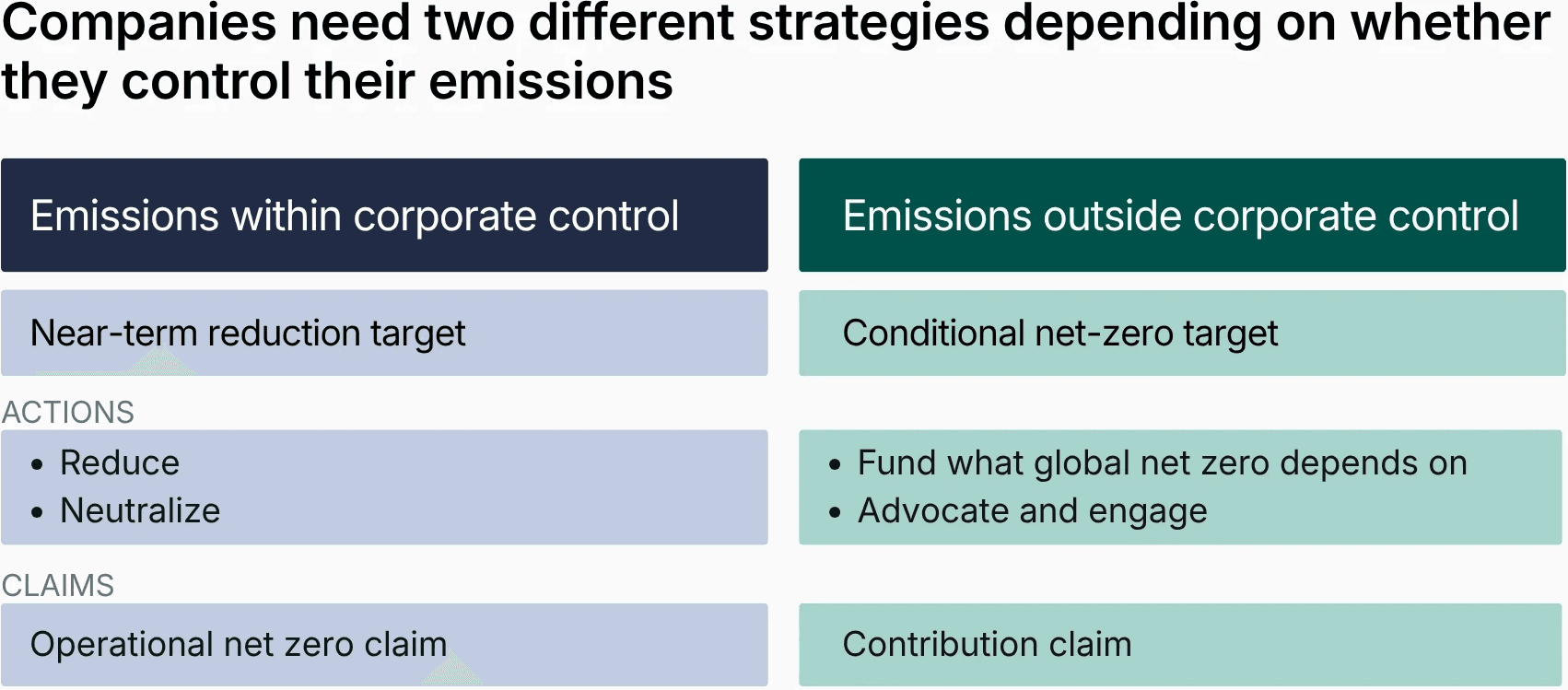
In A new lens on corporate net zero we detailed how full corporate net-zero targets depend on both emissions within and outside corporate control. Operational net zero sits within the first bucket. Here well defined reduction measures, carbon removal credits and other market instruments like power purchase agreements are appropriate.
But taking responsibility for direct emissions and reaching operational net zero does not release a company from responsibility for its value chain emissions. Companies should also spell out what wider change is needed for them to reach their full net-zero targets, and work towards that change, both through policy work and funding climate projects inside and outside their own value chains, even when those projects can’t count towards the corporate GHG emissions inventory.
Operational net zero is not the only credible near-term climate action a company can take. Setting a credible internal carbon fee and directing the proceeds to whatever projects best advance global net zero, without constraining the spend to what corporate GHG accounting will let the company claim, can represent a higher ambition level. The two approaches are not mutually exclusive: a carbon fee can fund both durable removal sized to residual emissions (which supports an operational net zero claim) and additional climate action that sits outside the accounting boundary. But many companies are motivated by funding action that counts toward their targets, and by being able to make claims. Operational net zero gives them a credible way to do that.
How operational net zero differs from related concepts
Operational net zero is distinct from other established frameworks and concepts.
Carbon neutrality, as governed by ISO 14068-1, requires demonstrated emissions reductions before offsetting residual emissions with carbon credits. The standard follows a hierarchical approach (reduce, then remove, then offset) and requires that credits meet quality criteria including additionality and permanence. However, ISO 14068-1 does not require carbon removal specifically, allowing for the use of avoidance and reduction credits to achieve carbon neutrality. Operational net zero is more rigorous from the outset: it requires that residual emissions be neutralized through carbon removal, not avoidance credits.
Beyond value chain mitigation (BVCM), reframed as "Ongoing Emissions Responsibility" in the SBTi's draft Corporate Net-Zero Standard V2, refers to climate investments beyond a company's value chain. These are contributions to the broader climate transition, such as funding carbon removal projects or supporting policy infrastructure, that are additional to a company's own decarbonization work. BVCM and operational net zero serve different functions and are not mutually exclusive. BVCM contributions are best used to take responsibility for the emissions within a company’s value chain that it has no control over. Operational net zero addresses only the emissions a company can eliminate through its own decisions and involves making a claim.
Net zero across the full value chain requires neutralizing residual emissions across Scope 1, 2, and all material Scope 3 categories, typically targeted for 2050. This remains the long-term goal for many companies. Operational net zero is a near-term milestone within that trajectory, covering the emissions a company can credibly deliver to zero by 2030.
Why operational net zero is important now
Corporate climate targets face a credibility reckoning with 2030 just four years away. Companies that made near-term commitments will soon have to show results or walk them back. The regulatory environment is tightening too. A vague ‘net zero’ claim is increasingly exposed to regulatory, legal, and reputational challenges. Companies that want to make credible climate claims in the near term need a target that's bounded enough to be achievable and rigorous enough to hold up under scrutiny.
Operational net zero gives companies something concrete and verifiable to point to: a bounded set of operational emissions, eliminated or neutralized. The bounded nature of the claim is what makes it defensible. It doesn't overstate what a single company can achieve and it doesn't let them off the hook for the emissions they do control.
Near-term targets also drive significant spending on external climate projects.
Budget approvals, executive tenure cycles, and annual reporting timelines all favor commitments with a defined deadline. A 2050 target, however well-intentioned, rarely generates an expenditure in 2026. A commitment for 2030 does, because it forces the company to quantify residual emissions and allocate budget now. That spending flows into climate solutions: clean energy procurement, electrification, efficiency upgrades, and carbon removal. Operational net zero turns corporate ambition into much-needed climate finance in the near-term.
Claims of target fulfillment drives action
We have long argued that companies should fund the most effective climate projects, regardless if they can account for that funding in their GHG accounting. But as we write in our five-year learning post, most companies want to be able to make claims about target fulfillment and have a hard time justifying investments that don’t contribute to this. That is the reality we live in. When high-integrity durable removals are used to neutralize remaining fossil emissions, near-term net-zero claims can retain integrity while motivating action that might not otherwise occur.
The data: what 158 companies with 2030 targets are doing
We analyzed 158 companies with near-term net-zero or carbon-neutrality targets for 2030 or earlier. We used the net-zero target database sourced from the Net Zero Tracker and enriched it with more companies whose targets we were previously aware of.
Almost all companies with 2030 targets cover a subset of their emissions, and more than half of companies with 2030 climate targets are covering more than just Scope 1+2 emissions.
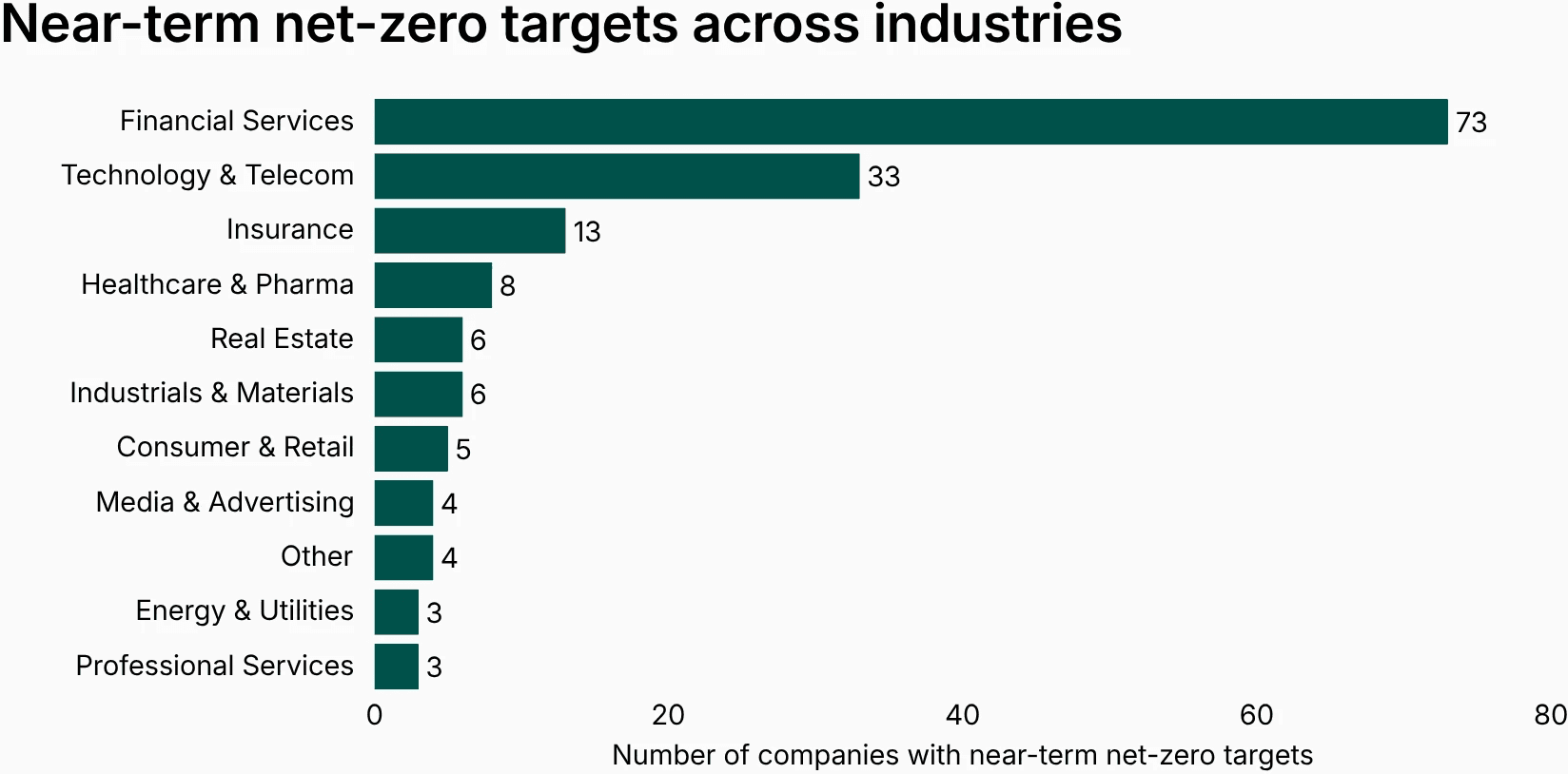
Financial services account for almost half of all near-term targets, followed by technology and telecom, and insurance. Among tech firms with 2030 targets, some pursue full value chain net zero (Microsoft, Meta, SAP), while others limit their targets to only their operations.
It is mainly “high-profit, low-emission” companies that have set these types of targets. Heavy emitters with low profit per tonne emitted would struggle to reach net zero for their Scope 1+2 emissions. This does not diminish the value of the operational net zero concept. Companies that can should be encouraged to take responsibility for their emissions and spend money on external climate projects.
Methodology and limitations
This analysis includes companies we identified as having a net-zero target for 2030 or earlier that covers operations only or operations plus selected Scope 3 categories. The starting point was the Net Zero Tracker dataset, supplemented by manual review of company disclosures.
Companies were included where public disclosures indicated a near-term net-zero target covering Scope 1 and 2, or Scope 1 and 2 plus selected Scope 3 categories such as business travel.
Public target language is often ambiguous. In some cases, inclusion reflects our interpretation of company disclosures rather than an explicit company use of the term "operational net zero".
Reviewed as of February 2026.
Examples of companies with operational net zero targets (and beyond)
The following companies illustrate different approaches to operational net zero, ranging from financial services to manufacturing to technology.
Nordea, the largest Nordic financial services group, targets a net-positive carbon contribution in its own operations by 2030, meaning carbon removal credits are planned to exceed residual emissions. Operational emissions totaled approximately 20,000 tCO2e in 2023, of which 79% was Scope 3 operational categories (business travel, purchased goods). Nordea has signed a multi-year BECCS agreement with Inherit Carbon Solutions for 68,000t CO2e of high-permanence removal. The bank has already achieved a 53% reduction against a 2019 baseline, exceeding its 50% target.
Heineken, is working towards net zero Scope 1 and 2 emissions and a 26% reduction in Scope 3 emissions by 2030 as well as full value chain net zero by 2040. Heineken has indicated it will begin procuring carbon removal to meet this requirement. Specific agreements have not yet been announced, but the commitment signals that emitters with significant process emissions are beginning to plan for removal procurement alongside reduction.
Swiss Re operates the CO2NetZero Programme covering Scope 1, 2, and selected Scope 3 (business travel, energy transmission, paper, water, waste) emissions, amounting to approximately 29,000 tCO2e per year. The company introduced a carbon steering levy in 2020 at $100/tCO2e, increasing linearly to $200/tCO2e by 2030. The share of carbon removal in the compensation mix increases by 10 percentage points annually, reaching 100% by 2030 (43% achieved in 2024). Swiss Re was the first to sign a long-term removal purchase agreement with Climeworks and is a founding buyer of the NextGen CDR Facility.
Schneider Electric targets “net-zero ready operations” by 2030 with a 90% targeted reduction in Scope 1+2 emissions against a 2017 baseline with removals for the rest. Schneider signed a 31,000-tonne carbon removal agreement with Climeworks spanning three pathways: direct air capture, BECCS, and enhanced rock weathering.
SAP targets full net zero by 2030 in all scopes, two decades ahead of its original timeline. Total Scope 1+2 emissions are approximately 110,000 tCO2e, with Scope 3 adding 1.5-6.8 million depending if use of sold products are included or not. SAP signed a 37,000-tonne removal agreement with Climeworks across three pathways suggesting the carbon removal procurement is sized to match estimated residual operational emissions.
IBM, aims to reach net-zero operational GHG emissions by 2030. They target a 65% reduction interim milestone by 2025 against a 2010 baseline. They expect residual emissions of 350,000 metric tons of CO2e or less at the target year, using feasible technologies to remove emissions in an amount equal to or exceeding residual amounts.
Several large tech companies, Google, Apple, Meta, and Microsoft, have full net-zero targets across all scopes by 2030. Microsoft goes the furthest as it committed to becoming carbon negative by 2030, removing more carbon than it emits across all scopes. In FY2025, Microsoft signed agreements to remove over 30 million tonnes of CO2, accounting for an estimated 81% of the entire durable carbon removal market. Microsoft has also operated an internal carbon fee since 2012, which was expanded to cover Scope 3 in 2020.
These examples are illustrative rather than exhaustive. They show the range of current practice and should not be read as a full endorsement of every aspect of each company’s climate strategy.
What companies should do now
We propose four criteria that distinguish a credible operational net-zero claim from a superficial one.
Strong action on reductions. The foundation of any operational net-zero claim is a demonstrated reduction trajectory. Electrification, renewable energy procurement, energy efficiency, and operational changes should drive emissions as close to zero as is feasible. Carbon removal neutralizes what remains after reduction has been maximized. For example, Schneider Electric has set a target of 90% reduction in Scope 1 and 2 emissions by 2030 relative to 2017. Siemens is targeting 90% physical reduction by 2030 and achieved 66% by 2024. These demonstrate that removal complements deep decarbonization and is only used when carbon removal is the cheapest option or the company lacks direct control over the remaining emissions.
Include all emission sources under direct corporate control. The operational boundary should make sense, and cover Scope 1, Scope 2, and any Scope 3 category where corporate decision-making can dictate whether reductions are possible. For most companies, this means business travel at a minimum. It would be especially important to include business travel for asset-light and service-based companies (financial institutions, professional services firms, technology companies), where it can be the largest emission source under direct corporate control. If additional Scope 3 categories fall under direct corporate control, they belong inside the boundary as well.
Neutralize remaining fossil emissions with durable carbon removal. Ongoing operational emissions should be compensated for using high-quality carbon dioxide removal. The like-for-like principle applies here: fossil emissions persist in the atmosphere for centuries to millennia, and the removals that neutralize them should store carbon on comparable timescales. Nature-based removals can complement these methods in a portfolio, but to credibly take responsibility for the climatic impact of fossil emissions, the removals should be durable.
Disclose annually, with specificity. Report each year on emissions reduced, residual emissions remaining, volume of carbon removal procured, the carbon removal methodologies used, and suppliers that were engaged. A company that publishes its residual emissions figure, names its carbon removal suppliers, and discloses the durability profile of its removal portfolio is making a claim that can be properly verified by external stakeholders.
This kind of specificity also tracks EU disclosure and consumer protection law: CSRD/ESRS E1 already requires companies to disclose targets, baselines, and the role of carbon credits and removals in meeting them, while The Empowering Consumers Directive prohibits whole-business environmental claims that overstate scope and requires forward-looking claims in commercial communications to be backed by a detailed implementation plan with measurable targets and regular independent third-party verification. All of which a credible operational net zero claim, disclosed annually with independent verification of the plan, should satisfy.
Making a 2026-2030 action plan
2026: Publish your operational boundary. Estimate 2030 residual emissions. Sign a first carbon removal agreement to build internal procurement capacity.
2027–2028: Report annually on reduction progress, residual trajectory, and carbon removal procurement. Expand removal agreements as supply develops.
2029–2030: Finalize neutralization of residual emissions. Publish a comprehensive operational net-zero claim with full methodology disclosure
What companies can credibly claim
A company that meets these criteria should say: ‘We have achieved operational net zero for Scope 1, Scope 2, and business travel in [year]. This claim does not cover our full value-chain emissions, for which separate targets and actions remain necessary.”
A company should not describe this simply as ‘we are net zero’ without making the boundary explicit.
Why durable removal is required
An operational net-zero claim is a claim that residual emissions have been neutralized, not merely that a company has funded climate action elsewhere. For fossil residual emissions, that requires like-for-like matching. Fossil CO₂ remains in the active carbon cycle for centuries to millennia, so the removals used to neutralize it should store carbon on comparable timescales. This is why durable carbon removal is the appropriate basis for fossil emissions in an operational net-zero claim, while avoidance credits and reversal-prone storage are not.
The standards landscape
No major framework currently names or credentials a bounded operational net-zero claim as a distinct milestone. The current landscape is evolving rapidly, and several frameworks are moving in directions that could accommodate what leading companies are already doing.
The SBTi’s Corporate Net-Zero Standard V2 (second consultation draft, November 2025) introduces an “Ongoing Emissions Responsibility” framework that incentivizes companies to finance external climate projects, while companies are still reducing their own emissions. They have a definition for full net zero including removals for residual emissions, but do not yet have claims guidance for partial targets like operational net zero.
The forthcoming ISO net-zero aligned organizations standard (ISO 14060), is in a committee draft stage and will need to address whether scope-bounded interim claims are valid. The VCMI Claims Code of Practice (V3.1, August 2025) is structured around full value chain ambition. While VCMI has published a separate Scope 3 Action Code of Practice (April 2025) for companies not yet able to meet Scope 3 targets, neither document currently provides a streamlined claim pathway for companies that have achieved operational net zero but are still working toward full Scope 3 alignment.
In each case, the direction is toward greater specificity on interim milestones and the role of carbon removal, but no framework yet gives companies a clear answer to the question: if I reduce my operational emissions aggressively and neutralize the residual with durable removal, what can I credibly claim?
Standard setters should explicitly recognize bounded interim claims, define minimum boundary requirements, require separation from full value-chain net-zero claims, and require annual disclosure of residual emissions and the instruments used to neutralize them
The four criteria proposed in this paper are offered as a contribution to that conversation. Until standards converge on a clear designation, companies will continue to use the same “net zero” language for fundamentally different levels of action, and the regulatory and reputational risks of unsubstantiated claims will only grow.
Conclusion
Of 158 companies with near-term net-zero targets, the majority have already limited their targets to operational emissions. Defining criteria that distinguish credible claims from weak ones would help improve quality. Formal recognition from standard setters that this practice is valid would accelerate adoption.
Beyond the 158 with 2030 targets, the broader group of 1,500 additional companies with long-term net-zero targets reveals a much larger opportunity. These companies already have reduction trajectories mapped out. Adopting an explicit operational net-zero commitment for the emissions they control and backing it with durable carbon removal for the residual would give them a credible near-term claim and accelerate the broader climate transition.
The path to credible climate action does not require waiting until 2050. Operational net zero gives companies a rigorous, achievable standard for the emissions they control, and formally recognizing it as a goal worth reaching can turn thousands of existing long-term reduction plans into near-term climate funding.
Operational net zero is not going to solve climate change, but it can motivate companies to make faster near-term reductions, finance climate solutions, and establish a credible basis for the claims they are already making. And for companies that do achieve operational net zero, it is not a finish line, they must simultaneously take action to address their other value chain emissions and support policy work that enables their ongoing emissions to be decarbonized.